 Solvprotocol
: Bitcoin Reserves, SolvBTC, and Yield Products
Solvprotocol connects Bitcoin reserves to decentralized finance through SolvBTC, a tokenized Bitcoin reserve asset. The protocol brings Bitcoin exposure into applications that need collateral, settlement assets, or liquidity across supported networks. Its product range separates that base asset from yield-bearing positions: xSolvBTC connects to staking, while BTC+ allocates capital across yield strategies. Those yield products add their own reward mechanisms and redemption terms to the underlying Bitcoin exposure.
Updated:
Where does SolvBTC fit in DeFi?
SolvBTC provides a common Bitcoin reserve asset for applications that accept it as collateral, a settlement unit, or a source of liquidity. Bitcoin exposure can arrive through different token representations on different networks, so SolvBTC's cross-chain role supplies a standardized reserve asset around which participating applications can build markets using a common unit.
Collateral acceptance belongs to the receiving application. A lending market determines borrowing conditions, while an exchange sets its own margin rules. SolvBTC's reserve model supplies the asset relationship underneath those uses; an integrated earn program supplies a separate arrangement for returns. The receiving application must support the specific SolvBTC token on the network being used.
Reserve custody, visibility, and yield execution
SolvBTC uses a 1:1 Bitcoin reserve-backing model. The backing can include native BTC and accepted wrapped Bitcoin assets. Custody, reserve reporting, and strategy execution perform different jobs within the architecture. A yield-bearing position adds strategy terms to that base relationship.
Bitcoin-mainnet custody
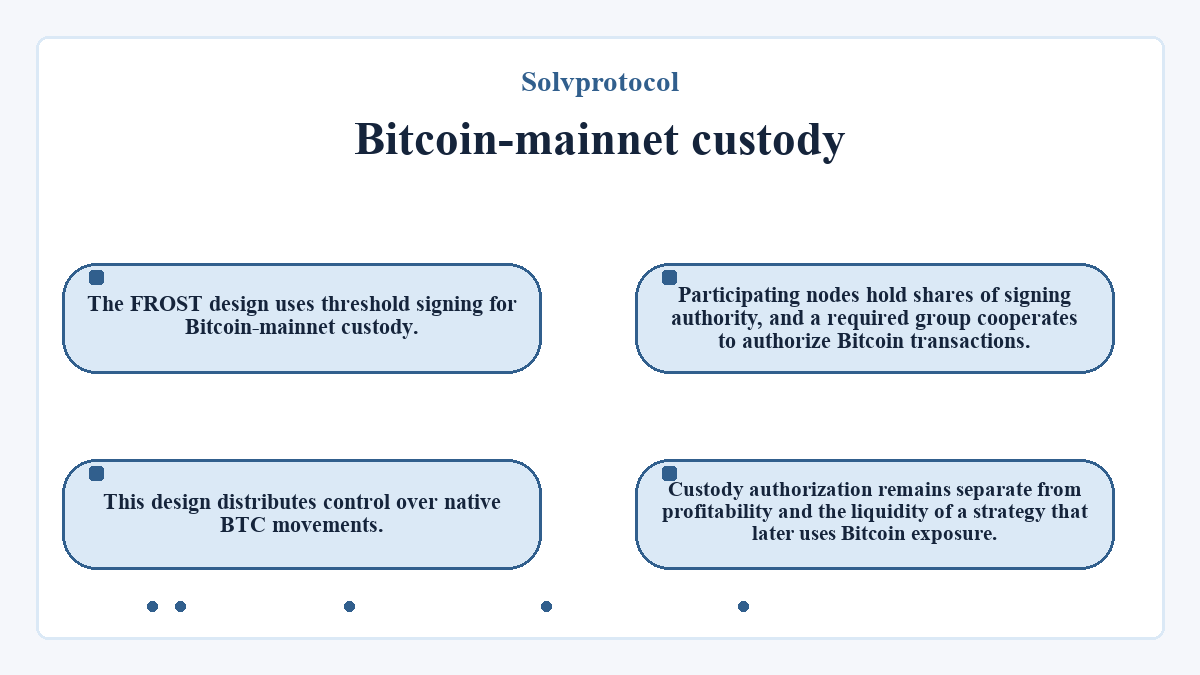
The FROST design uses threshold signing for Bitcoin-mainnet custody. Participating nodes hold shares of signing authority, and a required group cooperates to authorize Bitcoin transactions. This design distributes control over native BTC movements. Custody authorization remains separate from profitability and the liquidity of a strategy that later uses Bitcoin exposure.
Reserve visibility
Chainlink Proof of Reserves adds a reserve-verification component to the protocol's architecture. Reserve data concerns the assets supporting issuance, while a vault's strategy reporting concerns the deployment of its capital. A backing figure cannot replace the terms that govern the holder's particular yield product.
Staking Abstraction Layer
The Staking Abstraction Layer, or SAL, connects the reserve asset to staking and other yield strategies across ecosystems.
SAL separates reserve security from yield execution in Solv's design, connecting a common reserve asset to strategies that obtain rewards through staking arrangements or use offsetting positions to reduce directional market exposure. Each strategy retains its own execution and liquidity constraints. A liquid token makes a position transferable within compatible systems, while the underlying strategy continues to govern how that position earns rewards.
xSolvBTC and BTC+ yield structures
The yield products connect Bitcoin exposure to different sources of returns: xSolvBTC follows a staking-linked model, and BTC+ combines multiple vault strategies.
xSolvBTC staking exposure
xSolvBTC connects a liquid token to Bitcoin staking in the Babylon ecosystem. The token keeps the staking-related position usable in compatible DeFi markets, including lending and liquidity applications. Staking supplies the yield mechanism behind this product. Reward terms belong to that product and its underlying ecosystem, so holding a token with Bitcoin exposure does not establish a fixed interest rate.
BTC+ strategy allocation
BTC+ is a master yield vault that allocates capital across specialized sub-vaults, using an allocation model that responds to strategy performance, market conditions, risk profiles, and available liquidity as it rebalances the portfolio. The product records positions, allocations, and rebalancing on-chain, making its allocation structure different from a single staking-linked token.
Deposits produce BTC+ receipt tokens that represent the holder's vault share. The share connects a deposit to the combined strategy portfolio. Strategy selection and rebalancing happen within the vault model, while redemption follows the BTC+ product's own rules. A diversified allocation still exposes its holder to the strategies that the vault selects.
What does xSolvBTC instant redemption return?
The xSolvBTC instant-redemption feature returns SolvBTC through an on-chain conversion, so its output is the reserve token, not a native BTC payment to a Bitcoin-mainnet address.
Redemption contracts and dedicated liquidity buffers support that conversion. Native Bitcoin withdrawal has a different destination and needs its own supported process. BTC+ also has separate redemption arrangements, which should not inherit the xSolvBTC conversion's terms merely because both products use Bitcoin exposure.
In a hypothetical case, a holder has xSolvBTC and needs SolvBTC for collateral in an application that accepts it. Assume the selected network supports the conversion and the receiving application accepts that specific SolvBTC token. No native Bitcoin payment forms part of this requirement.
The xSolvBTC-to-SolvBTC conversion matches the required asset change. If the conversion completes, the holder receives SolvBTC, which satisfies the token requirement under those assumptions. Collateral eligibility still follows the receiving application's rules; the conversion itself does not establish an approved borrowing position.
A requirement for native BTC would change the conclusion, because receiving SolvBTC does not complete a Bitcoin-mainnet withdrawal.
SOLV utility and governance
SOLV is the protocol's utility token, with a role separate from SolvBTC reserve exposure and the yield positions represented by xSolvBTC or BTC+. Its utility includes governance participation, staking incentives, and protocol fee discounts, including SolvBTC redemption discounts. Governance can also affect SOLV issuance associated with Bitcoin Reserve Offerings. That token-supply mechanism concerns funding protocol-owned Bitcoin reserves; it should not be read as the reserve-backing ratio of SolvBTC.
Payment integrations and broader capital markets
Solv announced a BTC-backed payment partnership with AEON and fiat access through Alchemy Pay on August 6, 2025. Its wider strategy seeks to connect Bitcoin liquidity with real-world asset markets and institutional finance. These relationships extend the ecosystem beyond collateral and yield vaults. Each integration has its own asset and network coverage. Access through a payment provider and redemption from a yield product remain different services, with separate asset support and settlement terms.
Common questions about Solvprotocol
Will a BTC+ redemption return the amount that I originally deposited?
BTC+ redemption reflects the receipt tokens' current net asset value, which includes compounded yields minus applicable fees. The redemption value can therefore differ from the original deposit. Receipt-token units identify a vault share, so an unchanged token count does not imply an unchanged payout.
When does BTC+ process standard redemptions on EVM networks?
BTC+ standard redemption on EVM networks schedules days 1-9 requests for the 20th, days 10-19 requests for month-end, and later requests for the following month's 10th. Weekend processing moves to the next business day. Each request window closes at 23:59 UTC on its final submission day. Network congestion, protocol pauses, or vault constraints can delay processing or temporarily limit withdrawals.
Does the BTC+ instant-redemption option carry a fee?
BTC+ instant redemption on BNB Chain charges 0.25% of the redeemed amount. Per-transaction and shared daily limits apply, and a pending transaction reverts if the UTC day's shared cap is reached before it confirms. These conditions apply to BTC+ and do not establish the fee or capacity of xSolvBTC conversion into SolvBTC.
Can a standard BTC+ redemption request be cancelled?
A BTC+ standard-redemption request can be cancelled before its scheduled processing date. That cancellation window applies to the scheduled route.
Are BTC+ campaign incentives part of its regular vault yield?
BTC+ campaign incentives are separate from the yield that the vault compounds into its net asset value. The early-adopter SOLV campaign had an August 1-October 31, 2025 bootstrap period, with its snapshot ending early after the campaign reached its cap. For ongoing campaigns, BTC+'s redemption rules state that standard or instant redemption forfeits accumulated Reward Power and APY-boost eligibility. Promotional rewards follow the campaign's allocation and claiming rules.
Where do external rewards earned by BTC+ strategies go?
BTC+ converts external protocol rewards into SolvBTC and compounds them into the vault's net asset value. That treatment affects the value represented by the receipt tokens. It differs from a separately distributed promotional SOLV reward, which follows the campaign's allocation and claiming rules.