 Solvprotocol
 reserves back SolvBTC with BTC and accepted wrapped Bitcoin assets
Solvprotocol reserves provide the BTC and accepted wrapped Bitcoin assets that underpin SolvBTC's 1:1 Bitcoin backing. Chainlink Proof of Reserve, or PoR, makes reserve data available for comparison with the token supply. That comparison answers whether reported Bitcoin-equivalent backing covers the corresponding circulating SolvBTC. Custody, permitted reserve composition, and redemption settlement each affect how that backing reaches holders. A complete reserve assessment distinguishes reported coverage from control of the underlying assets and their availability for withdrawal. Staking positions introduce separate strategy exposure, even when they build on the same reserve asset.
Updated:
SolvBTC backing and yield-bearing balances
SolvBTC reserve coverage concerns the base reserve token; xSolvBTC and BTC+ add distinct yield arrangements to Bitcoin exposure. The relevant balance depends on which product the holder actually owns.
The Staking Abstraction Layer, or SAL, separates reserve security from yield execution. A staking return or strategy valuation answers a different question from the amount backing circulating SolvBTC. Reserve reporting supports the base-asset assessment, while a yield-bearing position also carries its own strategy and redemption terms. Matching reserves alone cannot establish the return from a particular yield product.
The coverage ratio and its limits
SolvBTC's reserve model targets one Bitcoin-equivalent unit of backing for each SolvBTC in circulation. Coverage compares eligible reserve assets with the corresponding token supply, using a consistent denomination and reporting scope.
Dividing BTC-denominated reserves by circulating SolvBTC produces the coverage ratio. A ratio of one represents 100% reported backing at that measurement point. Comparing reserve value in dollars directly with a token count would mix incompatible units. Both sides must describe the same Bitcoin-denominated obligation.
Coverage measures the reported quantity of backing. Custody arrangements determine who can authorize movement, and redemption arrangements determine how assets reach a holder. Those relationships explain why a fully matched reserve statement cannot, by itself, establish immediate withdrawal availability.
What does Chainlink PoR report about SolvBTC?
Chainlink PoR publishes reserve information that holders and applications can use to assess SolvBTC backing. The reporting connects assets held across Bitcoin and other networks with information available to on-chain systems.
Reserve-address coverage
The SolvBTC PoR feed on Ethereum mainnet uses a wallet address manager for addresses whose ownership the project self-attests. Its identified data source covers Bitcoin-network and cross-chain reserves. The address set matters because it defines which balances enter that reporting scope. A reported balance measures an address's holdings; self-attestation supplies the project's claim that the address belongs to its reserve set.
Data crossing between networks
Bitcoin assets and the token contracts that represent them need not reside on the same blockchain. Oracle reporting makes reserve information available across that separation. Publishing a reserve value does not move the underlying Bitcoin or deliver withdrawal assets. Those operations belong to custody and execution systems, which have their own authorization rules.
Core and innovative reserve assets
SolvBTC's documented reserve classification separates core assets from innovative assets. The category describes reserve treatment, rather than a guarantee that every listed asset supports every deposit route.
Core reserves
Native BTC and BTCB form the core group. Native BTC and a wrapped Bitcoin token retain different custody arrangements despite their shared Bitcoin denomination.
Innovative reserves
WBTC, FBTC, cbBTC, BTC.b, and tBTC appear in the innovative group. Their inclusion broadens the accepted reserve representations without making their individual backing mechanisms identical.
Minting limits and reserve-policy changes
SolvBTC minting through innovative reserves is subject to caps. Cross-chain rate limits provide a separate risk control over cross-chain activity.
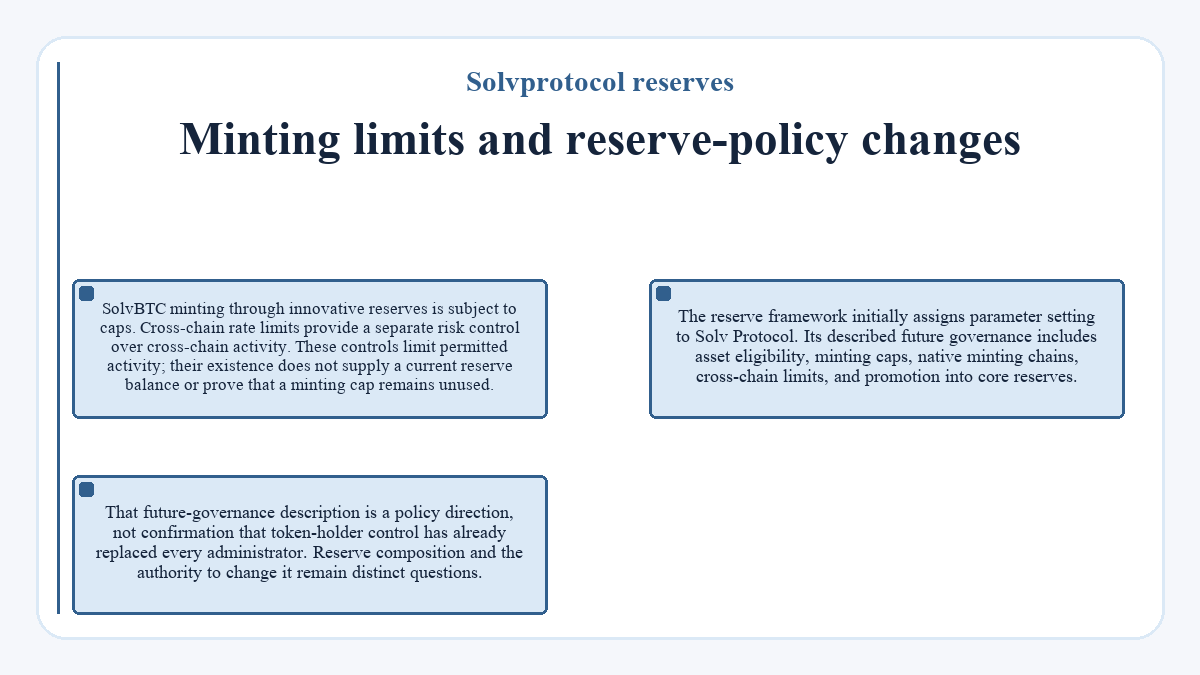
These controls limit permitted activity; their existence does not supply a current reserve balance or prove that a minting cap remains unused.
The reserve framework initially assigns parameter setting to Solv Protocol. Its described future governance includes asset eligibility, minting caps, native minting chains, cross-chain limits, and promotion into core reserves.
That future-governance description is a policy direction, not confirmation that token-holder control has already replaced every administrator. Reserve composition and the authority to change it remain distinct questions.
FROST custody and legacy reserve storage
FROST distributes native Bitcoin transaction signing among cooperating nodes, while the migration roadmap allows legacy storage to operate during a transition. Reserve totals alone do not identify the custody stage governing each asset.
Distributed Bitcoin signing
FROST nodes hold separate signing secret shares and cooperate to authorize Bitcoin transactions. A single FROST node cannot authorize a Bitcoin transaction by itself. The architecture supports active vault addresses and cold storage under a consistent signing model. Transaction signing also requires a sufficient subset of nodes to remain available.
Staged reserve migration
The SolvBTC Migration Roadmap describes legacy storage operating alongside FROST during its transition phase. In that phase, new deposits route to FROST, and redemptions prioritize hot-wallet liquidity before legacy cold reserves. Normal redemption activity progressively draws down legacy storage. The roadmap gives the end of 2026 as expected completion for full FROST infrastructure. That date states a target, rather than announcing that every Bitcoin reserve has already migrated.
How do reserve assets reach a redeeming holder?
Standard SolvBTC redemption burns submitted tokens after accepting a request, then records a claim before delivering the corresponding underlying reserve assets. The intermediate credential is a Redemption SFT, or semi-fungible token.
The Redemption SFT represents processing status and claim eligibility; this implementation does not use it as a transferable asset. Asset allocation then moves the corresponding reserves from the Safe Vault to the redemption contract within the applicable processing period. The holder claims those assets after allocation.
An accepted request therefore enters redemption processing. A reserve total cannot show that an individual claim has settled, and possession of the intermediate credential does not establish receipt of the underlying assets.
Coverage arithmetic before a redemption commitment
In this hypothetical example, a holder is choosing between retaining SolvBTC and requesting standard redemption. A synchronized observation shows 48.78 BTC-equivalent of eligible reserves against 48.78 circulating SolvBTC.
Coverage equals 48.78 divided by 48.78: one, or 100%. The calculation establishes matched reported backing for this hypothetical snapshot. A smaller reserve numerator, with supply unchanged, would reduce that coverage ratio.
Retaining SolvBTC leaves the holder's tokens unburned. Requesting redemption commits the submitted amount when the contract accepts the request and burns those tokens. The resulting Redemption SFT supplies processing and claim information while allocation remains outstanding.
A withdrawal requires the separate redemption commitment. Its completion evidence is the claimed reserve asset reaching the receiving wallet; the Redemption SFT alone records an intermediate state.
Reserve reports and their measurement periods
Solv's transparency presentation combines ongoing asset-backing visibility, weekly reserve proofs, and monthly custodian attestations. These reporting schedules describe different forms of evidence rather than one continuously refreshed report.
Solv presents weekly reserve proof as verification of backing-asset values and delta neutrality. Monthly custodian attestations address custodians' backing-asset values. A PoR observation supplies reserve data for its own reporting scope. Publication time, measurement time, and the period that an attestation covers can therefore differ.
A reserve comparison needs backing and supply figures whose coverage and timing align. Reusing an older attestation beside a later token-supply figure can leave intervening changes unexplained. A monthly report cannot establish movements after its measurement date, even when the report remains accessible.
Worth knowing
Must SolvBTC trade at exactly one BTC when reserves match supply?
A 1:1 backing model does not fix the price of every secondary-market trade. Reserve coverage concerns the assets backing circulating SolvBTC, while an exchange price reflects the terms available in that market. A quoted price and a reported reserve ratio measure different relationships.
What determines the minting fee for a wrapped Bitcoin reserve asset?
The minting fee depends on the wrapped Bitcoin input and the applicable fee configuration. FeeManager stores deposit fees by target token and deposit currency, then calculates the fee from the submitted amount and configured rate. An asset's reserve category does not establish a universal fee percentage.
Does Chainlink PoR automatically block every undercollateralized SolvBTC mint?
Automatic blocking requires a minting contract that uses reserve data to enforce a restriction. Chainlink PoR can support that design, but publishing reserve data does not itself establish the refusal conditions of every SolvBTC route. The applicable contract and configuration determine how a reserve observation affects issuance.
Does a failed reserve-feed lookup mean SolvBTC is underbacked?
A failed lookup establishes that the requested data was unavailable through that lookup. A deficit finding requires comparable reserve and supply figures; an error message does not supply that comparison. An older successful observation also remains tied to its original measurement point, rather than becoming a current balance.
Did the BRO Vault incident affect every SolvBTC reserve holder?
The Solv Team's March 30, 2026 post-incident review reported an impact limited to one non-public BRO Vault and two participants. It reported no impact on other products or public user funds, and full compensation by March 9.
Is a reserve surplus a substitute for a smart contract audit?
A reserve surplus does not test smart-contract code or deployment controls. Reserve reporting measures backing, while a security review examines implementation risks. Solv's March 30, 2026 post-incident policy required external audit review before ecosystem contract deployments, including private and one-time deployments.