 Solvprotocol
 staking: Choosing a BTC Yield Strategy
Solvprotocol staking connects Bitcoin-linked assets to yield strategies through the Staking Abstraction Layer. A staking decision starts with the return source and the asset that the position represents. xSolvBTC provides exposure to Babylon staking, while specialized Solv Vaults can use other staking systems, lending, liquidity provision, or trading strategies. BTC+ adds managed allocation across sub-vaults. Each option has its own reward accounting and redemption arrangements. A BTC-backed token balance, a growing redemption value, and a separate reward-token allocation describe different outcomes. Compare the accepted deposit asset, how earnings reach the holder, and what an exit returns before committing funds.
Updated:
Eligible tokens and the recorded xSolvBTC position
SolvBTC and supported wrapped Bitcoin inputs can fund xSolvBTC minting through the configured EVM router path. Asset support belongs to a particular network and route. An arbitrary Bitcoin wrapper cannot substitute for an accepted input simply because both track Bitcoin. The resulting xSolvBTC balance records the liquid staking position, while its valuation supplies the accounting basis for returns.
The underlying SolvBTC conversion burns SolvBTC and mints xSolvBTC shares. The router can handle an accepted wrapped input through its configured conversion path. These internal operations do not necessarily require separate user transactions.
The xSolvBTC pool calculates issued shares from the deposited SolvBTC value. Share quantity and redeemable value are separate measurements. The EVM valuation interface exposes net asset value and its latest update time.
The EVM router also enforces a minimum acceptable receipt amount. Its SDK initially returns a pending transaction object; that response alone does not establish a confirmed deposit or received shares.
Staking tokens and managed BTC yield
xSolvBTC, specialized Solv Vaults, and BTC+ offer different ways to place Bitcoin-linked capital into yield-producing activity. Their shared Bitcoin exposure does not give them identical revenue sources. Choosing between them means deciding whether the desired position follows Babylon staking, a selected vault strategy, or an allocated portfolio.
| Position | Asset and strategy scope |
|---|---|
| xSolvBTC | Bitcoin-linked exposure to Babylon staking; instant redemption returns SolvBTC. |
| Solv Vaults / LSTs | BTC or SolvBTC subscriptions into product-specific staking, lending, liquidity, or trading strategies. |
| BTC+ | A BTC-denominated portfolio that allocates capital across specialized sub-vaults. |
A liquid staking token, or LST, represents a position that can circulate while its underlying staking arrangement operates. A strategy vault can earn through other activities, including deploying borrowed funds or providing market liquidity. An individual vault follows its product-specific mandate, while BTC+ can rebalance the mix of specialized sub-vaults behind a position.
Where do the returns from a Solv Vault appear?
Solv Vault returns can increase the receipt token's redemption value or arrive as separate external rewards, depending on the selected product. For NAV-increasing vaults, yield converts into SolvBTC and enters net asset value, or NAV. Periodic valuation updates record that growth, which the holder realizes through redemption. External points or tokens follow a different distribution arrangement. An unchanged number of receipt tokens can therefore coexist with a higher recorded value. A separate reward allocation, meanwhile, does not automatically increase the SolvBTC amount represented by those receipt tokens.
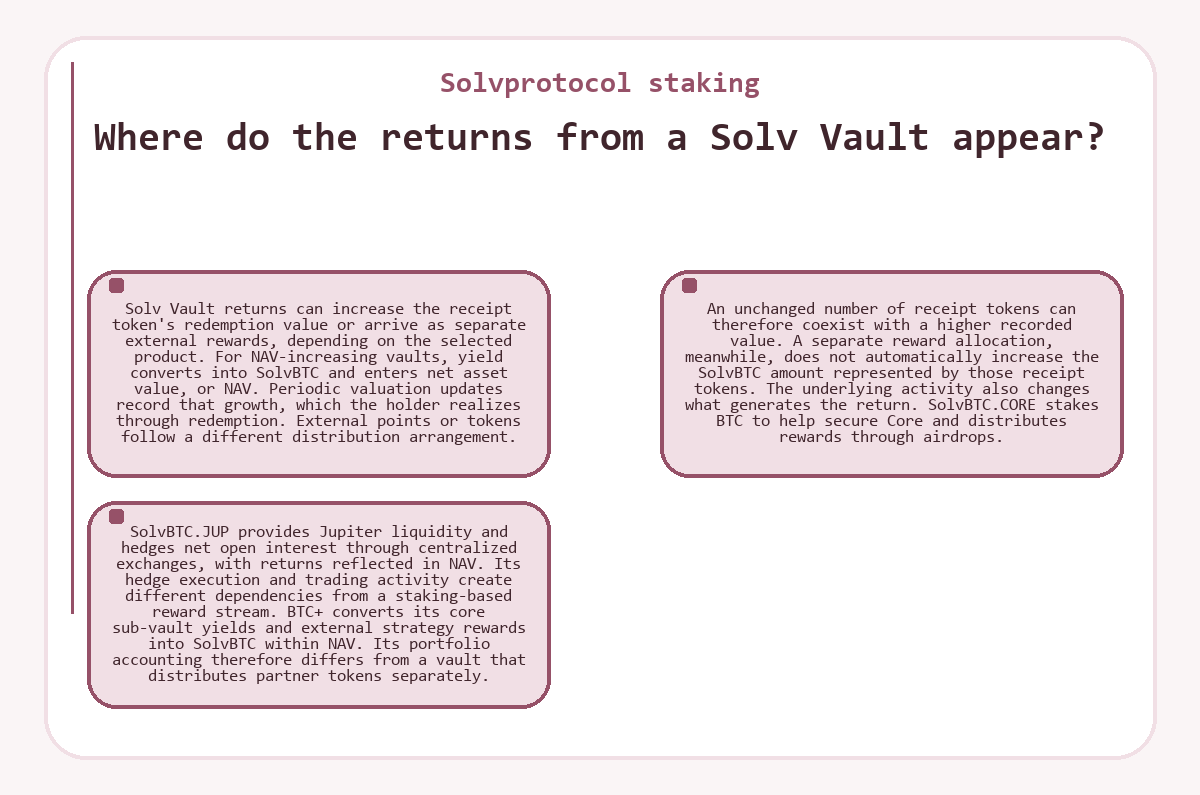
The underlying activity also changes what generates the return. SolvBTC.CORE stakes BTC to help secure Core and distributes rewards through airdrops. SolvBTC.JUP provides Jupiter liquidity and hedges net open interest through centralized exchanges, with returns reflected in NAV. Its hedge execution and trading activity create different dependencies from a staking-based reward stream.
BTC+ converts its core sub-vault yields and external strategy rewards into SolvBTC within NAV. Its portfolio accounting therefore differs from a vault that distributes partner tokens separately.
Withdrawal value, fees, and settlement assets
xSolvBTC instant redemption converts the position into SolvBTC, while other Solv Vaults follow product-specific processing schedules. The instant conversion uses on-chain contracts and liquidity buffers. Receiving SolvBTC completes that conversion; delivery of native BTC follows a separate redemption process for the reserve asset.
The xSolvBTC pool applies its configured withdrawal fee to the gross SolvBTC value of redeemed shares. The fee basis includes the principal represented by those shares. Its rate is configurable, so the word instant establishes neither a zero fee nor a fixed net output.
The SolvBTCRouterV2 deposit path can also charge an input-token fee, configured by input asset and target token. Network transaction fees add another cost. A shorter holding period gives entry and exit costs less time to be offset by strategy earnings. No fixed yield figure determines that relationship across every deposit and route.
SolvBTC.CORE schedules redemption processing at the beginning of each month. When a scheduled processing date falls on a weekend, processing moves to the next business day. That window affects access to the returned assets and differs from xSolvBTC's instant conversion into SolvBTC.
SAL coordination behind the staking position
The Staking Abstraction Layer coordinates token issuance, staking verification, transaction construction, and yield distribution across participating systems. Liquid staking token issuers, staking protocols, guardians, and yield distributors perform different roles within that arrangement. The Staking Abstraction Matrix supplies transaction rules, validation criteria, and yield calculations to its technical services. A common interface can therefore connect several economic mechanisms without making their rewards interchangeable. Reserve custody remains a separate dependency from the activity that generates a position's return.
Strategy risk beyond Bitcoin backing
Bitcoin backing describes the reserve relationship, while strategy risk concerns the activity that produces earnings. Borrowing-based positions can face liquidation, and liquidity strategies can lose BTC units under adverse conditions. A trading hedge introduces execution requirements and can involve a centralized counterparty. BTC+ spreads allocations across strategies, yet its risk framework still recognizes contract faults, oracle problems, counterparty failures, and withdrawal constraints. Rebalancing changes exposure to those risks; it does not establish a fixed payoff. The selected vault's actual activity determines which dependencies matter to a staking decision.
BTC-denominated performance also differs from fiat performance. A position can gain BTC units while losing fiat value when Bitcoin falls. BTC+ retains Bitcoin price exposure, so its yield strategy does not insulate the holding from that market movement.
Bitcoin yield and SOLV-token staking
SOLV-token staking uses a different deposit asset and reward arrangement from Bitcoin-linked staking products. The Mellow route takes SOLV on BNB Chain and requires BNB for transaction fees. It provides stSOLV as a receipt that holders must then stake to earn incentives in vSOLV, a time-locked reward token.
Staked SOLV can serve as collateral for Symbiotic-based security, which introduces economic penalties for misbehavior. Holding stSOLV represents a SOLV staking position. xSolvBTC and BTC vault receipts serve the Bitcoin-linked purpose of the other choices, with different underlying activities and exit terms.
Helpful answers about Solvprotocol staking
Is the xSolvBTC BABY wallet-linking campaign still open?
The xSolvBTC BABY airdrop's wallet-linking window closed on June 9, 2025. The campaign linked EVM and Babylon addresses and planned its last distribution batch after that deadline. Those terms concern a historical allocation; a later xSolvBTC purchase does not reopen that closed wallet-linking process.
What happens to staking rewards during a pending SOLV withdrawal?
The stSOLV amount placed into pending withdrawal stops earning rewards when its withdrawal request starts. The Mellow-based SOLV route specifies a 22-day withdrawal cycle. Separate requests have separate timers, and pending stSOLV cannot be reused or restaked before the claim.
Why might a Solv Vault partner reward require a separate claim?
Some Solv Vault partner rewards require a claim after the partner's token generation event. Other external rewards arrive through direct airdrops. The applicable distribution determines whether a claim is necessary, so possession of a vault receipt alone does not establish that every associated reward has already reached the holder.
Does xSolvBTC availability on a chain mean every staking action works there?
A network's xSolvBTC support does not establish that every minting, redemption, or DeFi integration operates there. Token deployment, configured deposit assets, and application support describe different capabilities. The EVM router and SDK describe EVM operations; their functions do not establish identical transaction methods on other supported networks.
Are Mellow and Symbiotic points the same as vSOLV staking rewards?
Mellow and Symbiotic points are separate from the vSOLV rewards offered through SOLV staking. A points balance records program participation and differs from a received token balance. The points total alone does not specify a conversion rate or establish how much spendable SOLV a participant can obtain.